Event Infrastructure for Real-Time and
AI-Native Systems.

Stream, store, query, and coordinate distributed systems and AI agents on one durable foundation.

One durable log for every real-time path.

live

Publish from

Applications

services and products

Agents

workflows and memory

Data changes

events and CDC

publish onceconsume many ways

Durable append log

ordered · retained · replayable

1234
order.createdack
1235
memory.updatedack
1236
state.changedack
1237
context.removedack

Use as

Streams

consume by offset

Views

query live state

Agents

replay decisions

One ordered history keeps producers simple and every reader independent.

One client, one grammar

Eight primitives.
One grammar.

Every primitive is one accessor and one verb. Publish a record, query a projection, or ask an agent: every call takes the same shape, object.verb(input).await.

Event Streaming
Agent Primitives

laser.topic(name)

Log

Publish and consume records, replay by offset, batch.

laser.query(index)

Views

Filter, aggregate, page, and vector-search declared projections.

laser.graph(name)

Graph

Link entities, traverse, and find neighbors and nearest vectors.

laser.watch()

Change feed

Await a view's advance instead of polling it.

laser.kv(ns) / .fork(id)

State

Point reads and writes, CAS, leases, copy-on-write branches.

laser.memory(scope)

Memory

Remember, recall (semantic, keyword, hybrid), consolidate.

laser.context(id)

Context

Assemble one conversation's record and scope its memory to it.

laser.agent(id) / .workflow(..)

Fabric

Directed asks, deadline contracts, ordered workflows, runs.

Inside the fabric

The part most systems bolt on separately. Here it stays conventions over the log, so agents inherit durability, replay, and ordering for free.

Read the AGDX protocol

Discovery

Agents advertise a capability card and a live inbox in one health-aware registry.

Coordination

A directed ask with a deadline, a fan-out to every capable agent, or a pause for a human.

Workflows

Dependency-ordered steps with saga compensation and crash-recovery replay from a journal.

Governance

ActionGovernor reviews every send: allow, block, step up, modify, or defer, with digest-chained evidence.

Durable intent

Typed votes bind a threshold of signers to one effect. It runs only once its exact digest is authorized.

Runs

Submit a run, read its state, list by filter, cancel. Folded from the log itself.

Laser SDK

A small streaming API
with room to grow.

The first calls are topics, records, and offsets. Query, state, and agent coordination stay explicit layers.

// npm i @laserdata/laser-sdk
import { Laser } from "@laserdata/laser-sdk"

const laser = await Laser.connect(
  "user:[email protected]"
)

const orders = laser.stream("commerce").topic("orders")
await orders.ensure(4)
await orders.publish().json(order).send()

const rows = await laser.query("orders_v1").filterEq("status", "paid").fetch()
const facts = await laser.memory("support").recall().semantic("refunds").fetch()
await laser.kv("sessions").set("user:42").json(session).send()

Typed streaming runs on Apache Iggy. Query, KV, and memory light up on LaserData Cloud.

TypeScript examples

Use Cases

Four ways to build on
one durable history.

Start with direct streaming and add delivery semantics, live projections, or replayable agent coordination only where the use case needs it.

Apache Iggy foundation

Typed records. Direct control of the log.

Publish, batch, consume, and replay with caller-owned offsets. Reach the Apache Iggy client directly when the hot path needs it.

Surface

streams / partitions / offsets

Result

Replayable hot path

Best when you need

typed JSON, CBOR, or bytes

explicit partitioning

opt-in batching

Each use case keeps the same retention, ordering, offsets, and replay model underneath.

Apache Iggy engine result

2M+msg/s

Single-node throughput

1 GB/s send, 2 GB/s poll

Real-time starts at the storage engine.

Published Apache Iggy benchmark results on an AWS i4i.4xlarge.

0.495ms

consumer P99

0.357 ms average

0.976ms

producer P99

0.466 ms average

40Mmessages

benchmark run

persistent log workload

Producer 0.47 ms avg
Consumer 0.36 ms avg
40M messages · 1 GB/s write · 2 GB/s read
ms
1.0
0.8
0.6
0.4
0.2
0.0
Time
Rust, no GCzero-copy readsthread-per-coreio_uring I/O

AWS i4i.4xlarge. Producer and consumer methodology published with the raw results.

One log in the middle

Tools stay at the edge.
Durable data stays in the middle.

Point-to-point wiring turns agent logic into integration logic. Publish once instead, and let every store, protocol, and consumer evolve independently around the same history.

Point-to-point

Orchestration as integration hub

N x M
01

Route agent calls

MCP and A2A

02

Synchronize context

cache and vector DB

03

Write durable events

stream broker

04

Copy every outcome

analytics and audit

Every new system changes orchestrator code.

Log-native

Orchestration stays workflow logic

N + M
01

Protocols at the edge

publish ordinary records

02

Shared history

rebuilds from offsets

03

Apache Iggy

retains and replays

04

Independent readers

subscribe at their own pace

Add a reader without changing the writer.

Into the platform

Ordinary producers

servicesagentsCDCHTTP sources

From the platform

Independent edges and readers

MCP / A2AAG-UIanalyticssearchobservabilitydata lake

MCP and A2A coordinate. AGDX moves what agents know. A2A speaks SendMessage and GetTask over a signed agent card, MCP maps tools, resources, and prompts, and AG-UI streams state snapshots and deltas, all into the same AGDX envelope. No SSE, no side channel.

Explore integrations

Reference app: Photon Market. Follow one order through log-only services, recovery, analytics, and governed agent actions.

View the example

Inside the LaserData console

One console for the whole platform.

Provision a deployment, then browse the streams, projections, memory, and agents running inside it.

One deployment, every detail.

Tier, region, storage, and the exact TCP, QUIC, HTTP, and WS ports your connection string resolves to. Logs, heartbeats, and connectors sit one tab away.

laserdata.cloud
LaserData deployment console showing environment details, connection ports, and a quick start guide
LaserData deployment console showing CPU, memory, and Apache Iggy runtime metrics
LaserData console overview showing stream counts, server info, and managed data primitives
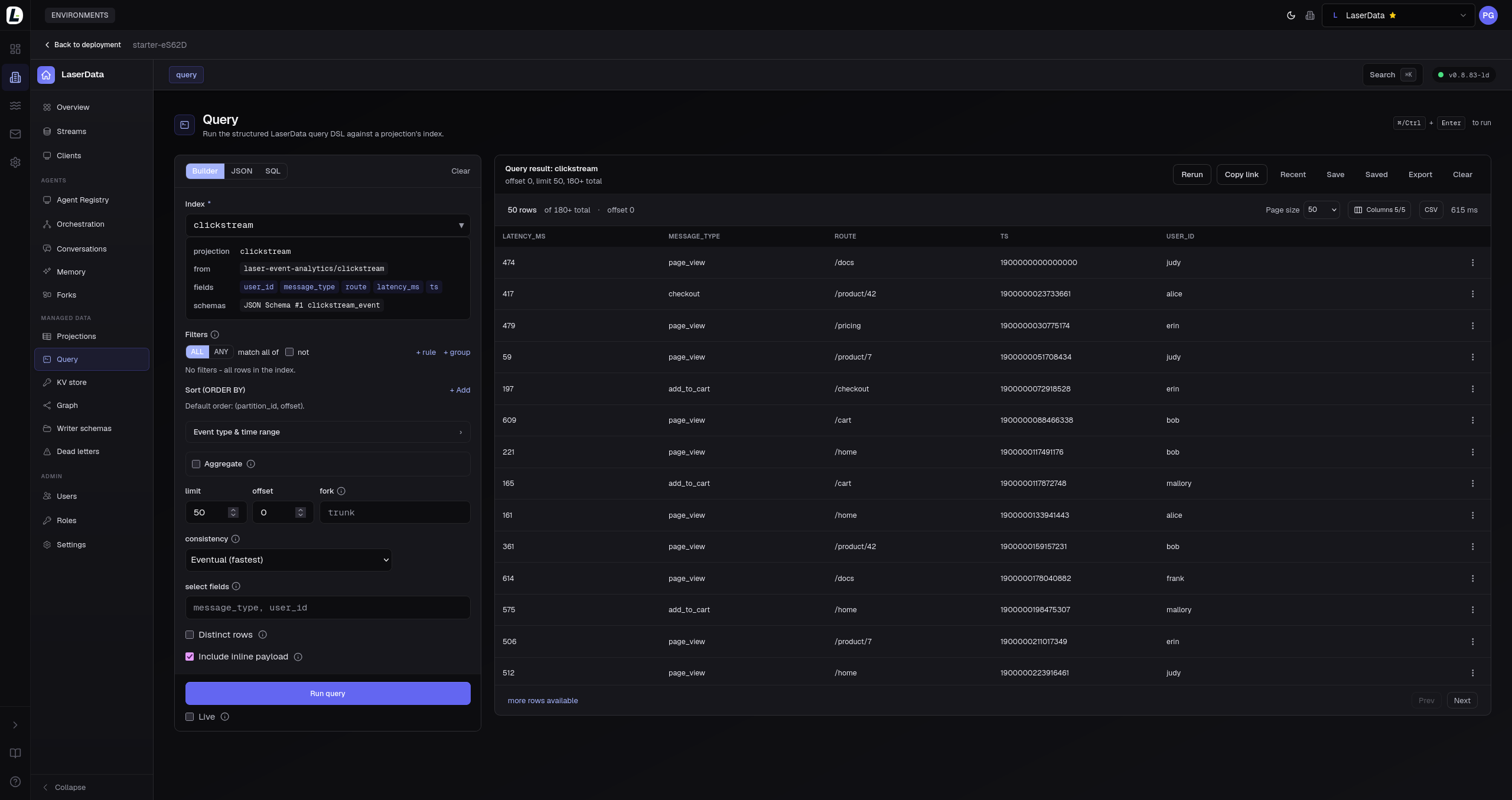
LaserData console query builder running a structured query against a clickstream projection
LaserData console conversations view showing an agent message timeline and token usage by agent
LaserData console memory browser showing recalled facts filtered by namespace
LaserData console role editor showing capability grants for KV and memory access
LaserData console message detail panel showing AGDX headers, checksum, and JSON payload
01
08

One path from local to managed

Start with a topic.
Add capabilities as you grow.

Keep the streaming path simple and make every higher-level capability an explicit choice.