
Laser SDK
One SDK for the data your agents and services depend on
Agent teams usually wire a queue, a cache, a vector store and a state database together, then write the code that keeps them consistent. The Laser SDK gives you typed primitives for log, context, memory, state, graph, views, changes and coordination, all backed by the same durable history.
- Languages
- Python, TypeScript and Rust
- Primitives
- Eight, all over one log
- Bridges
- A2A, MCP and AG-UI
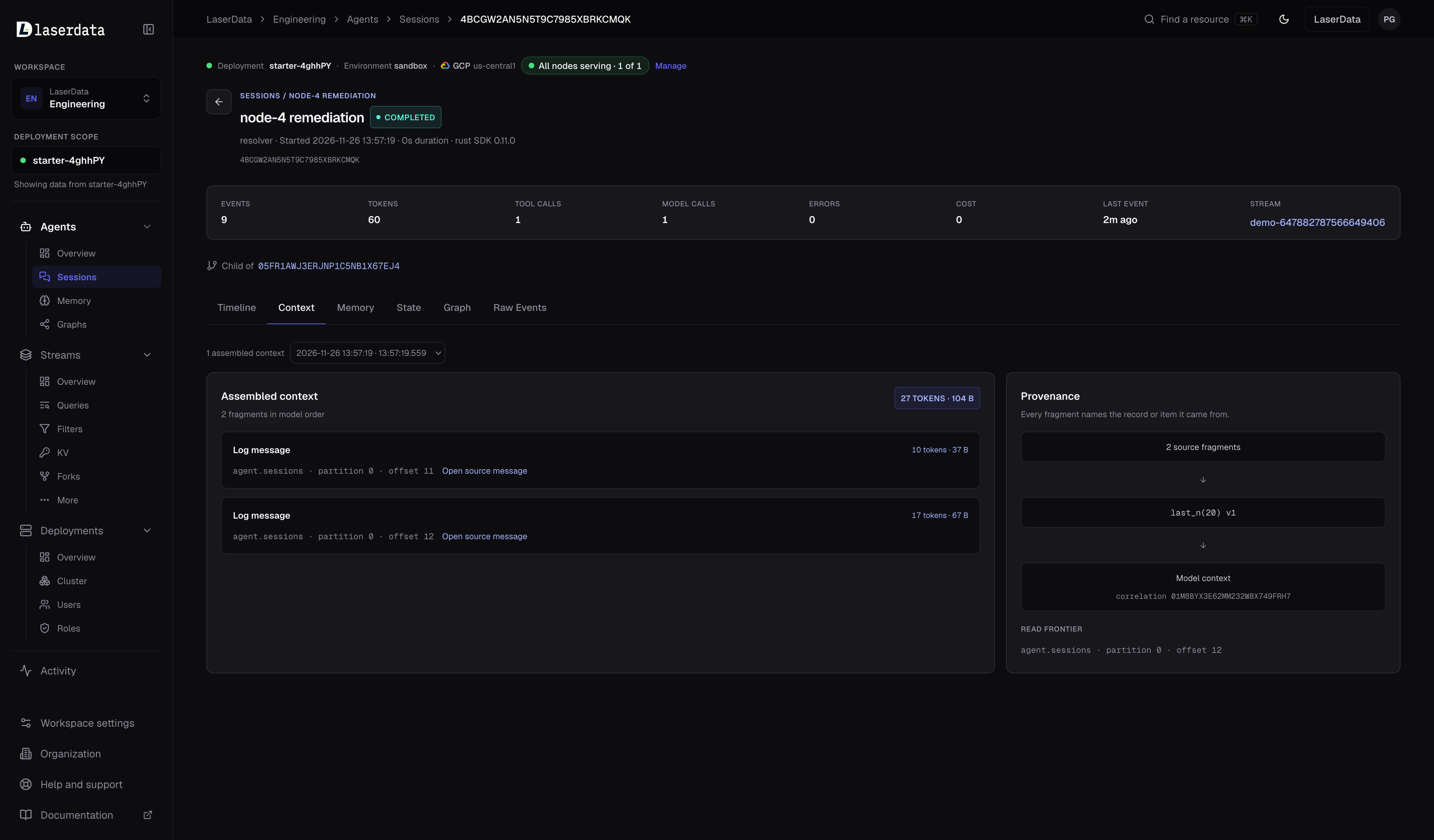
Swipe to see the whole screen
The outcome
Build on one coherent API instead of bespoke plumbing.
Eight primitives
Log, context, memory, state, graph, views, changes and fabric.
Three languages
Python, TypeScript and Rust from the same model.
Declared policies
Context windows and retention are explicit, reviewable code.
Open bridges
A2A, MCP and AG-UI bridges connect outside clients to agents on the log.
In code
One sample per primitive. Three languages.
Apache 2.0, on PyPI, npm and crates.io. Every sample here is taken from the SDK's own examples.
python -m pip install laser-sdk
npm install @laserdata/laser-sdk
cargo add laser-sdk
Publish typed messages to a topic and read them back.
About Log@dataclass
class Reading:
host: str
cpu: int
topic = laser.stream("fleet").topic("readings")
await topic.ensure(partitions=4)
readings = topic.json(Reading)
await readings.publish(Reading(host="node-7", cpu=82)).send()
# read the messages back as typed values
reader = readings.records("dashboard")
while (record := await reader.next()) is not None:
print(record.value.host, record.value.cpu)How it works
Architecture
Source of truth
- 0010session.startedagent: resolver
- 0011tool.calldrain_host
- 0012tool.resultdrain_host · 67 bytes
- 0013model.requestdemo-model
- 0014context.assembledlast_n(20) · 27 tokens
Derived views
Context
Prompt-ready conversational history.
Memory
Durable recall across interactions.
State
Working state and coordination.
Graph
Relationships across entities and events.
Views
Materialized projections from history.
Changes
React to updates without blind polling.
Fabric
Durable agent-to-agent coordination.
Explore the platform
One platform, every layer.
Build
The data layer your applications and agents write to.
- Agent SessionsRecover, inspect and continue long-running agent work.
- Data StreamingMove more data with a smaller infrastructure footprint.
- Laser SDKYou are hereBuild on one coherent API instead of bespoke plumbing.
Run
Where it runs and how access and data are protected.
Expand
Connect more systems and see what is happening inside.
Evaluate it in your environment.
Architecture, workload and deployment constraints determine the right next step. We review them with you before recommending a path.